
Overview
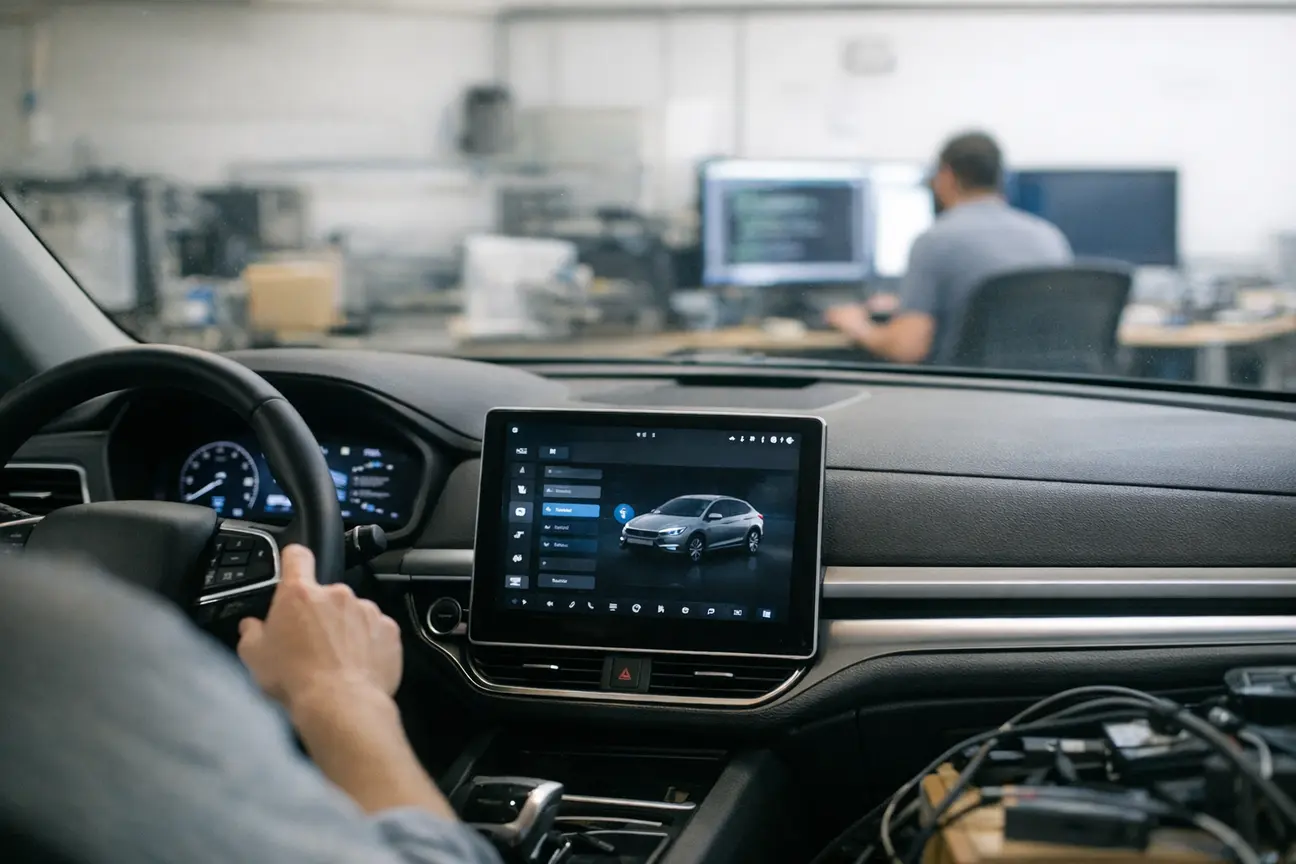
ThunderSoft announced AquaDrive OS 2.0 Pre at CES 2026, a pre-release, AI-native vehicle operating system intended to accelerate intelligent cockpit and in-vehicle AI deployment. Building on AquaDrive OS 1.0 (already used in production EVs, per the company), the update emphasizes a unified user experience, embedded AI by design, and faster paths to production.
What’s new
- AI-native architecture: End–edge–cloud collaborative framework with multimodal perception, contextual memory, and cross-domain intelligence.
- Unified cockpit visualization: Central display linked to panoramic visual domains to enhance situational awareness without sacrificing clarity.
- Fusion Reality HMI: Consolidates lane maps, “Surrounding Reality,” and around-view panoramas into a single display layer to reduce interface fragmentation.
- Contextual, gaze-aware interaction: Proactively surfaces navigation, alerts, and key info; interface elements adapt to driver line of sight.
- Scenario-based AI agents: Operate from start-up through driving and parking to anticipate intent and deliver proactive assistance.
- Real-time 3D rendering: Dual-display support, >6.5 million high-fidelity surfaces, and real-time lighting for smoother visual transitions.
- Latency target: Sub-500 ms for time-sensitive driving scenarios locally, with cloud intelligence for more complex tasks.
- AI-first interaction model: Natural-language intent handling with Generative HMI for adaptive, personalized cockpit experiences.
- Scalability and integration: Multi-platform baselines across major automotive SoCs; described as hardware-agnostic to speed integration.
- Flexible deployment models: Intelligent cockpit; cockpit–drive integrated; or cockpit + AIBOX for added AI compute.
- AIBOX hardware approach: Software–hardware co-optimization aimed at alleviating in-cabin compute bottlenecks and enabling large AI models.
- Ecosystem partnerships: Integrations with AISpeech, Here, Dirac, Etas, ModelBest, Qwen, and Volcano Engine.
Why it matters
- Positions a standardized path to bring large AI models into vehicles at scale (with partners such as Nvidia and Qualcomm).
- Aims to balance cost and performance via cross-domain integration and targeted on-vehicle compute.
- Seeks to streamline driver interaction and reduce cognitive load through unified visualization and proactive UI behavior.
- Targets faster time-to-production for automakers through multi-platform baselines and hardware-agnostic design.
Technical highlights
- Unified cockpit architecture linking central and panoramic domains.
- Fusion Reality HMI to merge disparate visual feeds into one coherent layer.
- Dual-display real-time 3D, >6.5M surfaces, and lighting effects for continuous transitions.
- End–edge–cloud orchestration to keep latency-critical tasks local while offloading complex reasoning to the cloud.
Deployment options
- Intelligent cockpit configuration for core HMI and interaction.
- Cockpit–drive integration for tighter cross-domain intelligence.
- Cockpit + AIBOX to scale AI compute for large models and feature growth.
Ecosystem and readiness
- Integrated partner network to localize and extend features by region and segment.
- Company states AquaDrive OS 1.0 informed 2.0 Pre via real-world deployments.
Unknowns and caveats
- No launch customers or timelines disclosed.
- Several benefits are company claims and will need validation in production vehicles.
- Cloud-extended features may depend on connectivity and regional data policies.
Bottom line
AquaDrive OS 2.0 Pre advances an AI-first, unified cockpit vision with proactive interaction, agent-based assistance, and a flexible compute strategy via AIBOX. If realized in production, it could help automakers speed rollout of intelligent, personalized in-vehicle experiences while managing cost and performance trade-offs.