
Summary
General Motors plans to record $7.1 billion in fourth-quarter charges, driven by a pullback in North American EV investments and a shift of capacity toward full-size pickups and SUVs amid softer EV demand, reduced consumer tax incentives, and easing emissions requirements.
Key numbers
- $6.0B tied to North American EV strategy changes:
- $1.8B non-cash write-down of EV manufacturing assets
- $4.2B in supplier contract settlements, primarily battery agreements
- $1.1B related to restructuring the SAIC General Motors joint venture in China (supplier claims and legal accruals)
What’s changing operationally
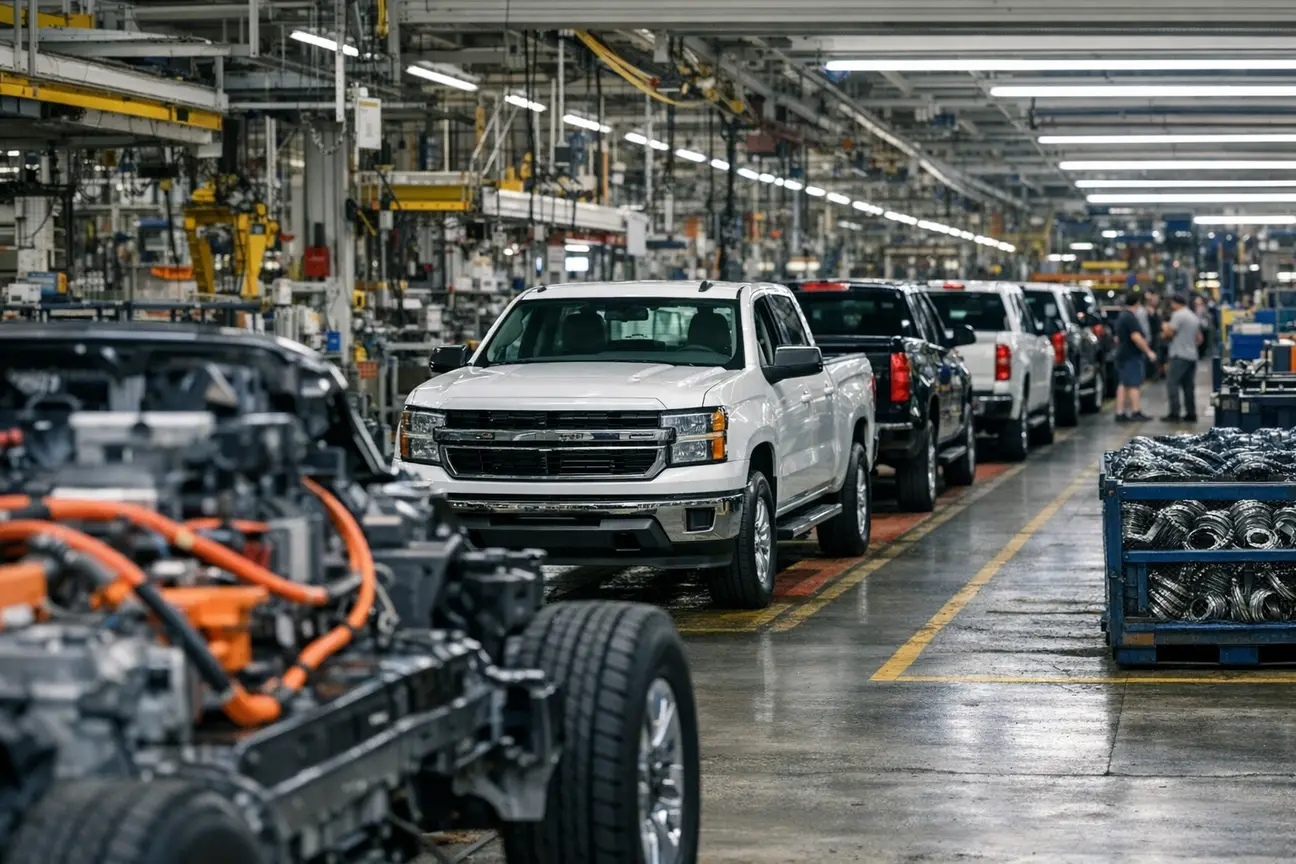
GM is reallocating production toward high-demand internal combustion models and scaling back some EV capacity.
- Ramping up output of full-size pickups and SUVs to address “unmet demand.”
- Pivoting the Orion Assembly plant (Michigan) from EVs to full-size SUVs and pickups with internal combustion engines.
EV lineup status
GM says EVs already in retail production will remain available, including Chevrolet Equinox and Bolt EV, Cadillac Lyriq SUV, Chevrolet Silverado EV, and GMC Hummer EV.
Workforce impacts
The company previously confirmed about 3,400 job cuts at EV and battery facilities as production is scaled back, including positions at Factory Zero (Detroit) and the Ultium Cells plant (Warren, Ohio). Most layoffs took effect Jan. 5.
Prior actions
In October 2025, GM’s audit committee approved a $1.6B impairment to realign EV manufacturing capacity, including $1.2B in non-cash impairments and $400M in cash costs for contract cancellations and settlements.
Outlook and risks
- Further, though smaller, cash and non-cash charges are expected in 2026 as supplier agreements are unwound or renegotiated.
- Proposed changes to greenhouse-gas standards could reduce the value of emissions credits, potentially driving additional impairments.
- GM plans to report fourth-quarter and full-year 2025 results on Jan. 27.
Industry context
The move aligns with a broader industry recalibration as EV sales growth moderates. Ford has also scaled back near-term EV targets, shifting focus to internal combustion F-Series, more hybrids, and smaller, more affordable EVs. Ford expects about $19.5B in nonrecurring costs tied to its revised strategy, largely in Q4 2025.
Bottom line
GM is prioritizing profitable, high-demand trucks and SUVs while keeping its current EVs on the market. The sizable charges reflect the cost of unwinding portions of its rapid EV expansion and rebalancing toward segments core to its North American business.